Can a smart smart socket be used with high - power appliances?
Leave a message

Smart sockets have emerged as a convenient addition to modern households, promising enhanced control and automation for various electrical devices. As a supplier of smart sockets, it's a question I'm frequently asked: Can a smart socket be used with high - power appliances? This blog post delves into the technical aspects, potential risks, and practical considerations to provide a comprehensive answer.
Understanding Smart Sockets
Smart sockets are intelligent devices that connect to your home's Wi - Fi network, allowing you to control the power supply to plugged - in appliances via a smartphone app or voice commands. They offer features such as remote control, scheduling, and energy monitoring, making them a popular choice for tech - savvy consumers.
The basic functionality of a smart socket involves an internal circuit that can be switched on and off remotely. However, the components within a smart socket have their own electrical limitations. These limitations are determined by factors such as the gauge of the internal wiring, the capacity of the relays, and the thermal tolerance of the materials used in the socket.
High - Power Appliances: What Constitutes High Power?
High - power appliances are those that draw a significant amount of electrical current to operate. Common examples include electric heaters, air conditioners, electric kettles, and large refrigerators. In general, appliances with a power rating above 1000 watts are considered high - power devices.
The power (P) of an electrical device can be calculated using the formula P = VI, where V is the voltage and I is the current. In most residential settings, the standard voltage is around 120V in the United States and 230V in many other countries. So, for a 1500 - watt heater in a 120V system, the current drawn would be approximately 12.5 amps (I = P / V = 1500W / 120V).
Compatibility of Smart Sockets with High - Power Appliances
Technical Limitations
Smart sockets are designed with specific current and power ratings. Most standard smart sockets on the market are rated for a maximum current of around 10 - 15 amps. This means they can safely handle appliances with a power rating of up to about 1200 - 1800 watts in a 120V system.
Exceeding the rated current of a smart socket can lead to several problems. Firstly, the internal wiring may overheat due to the increased resistance caused by the high current. This overheating can damage the insulation of the wires, potentially leading to a short circuit or even a fire hazard. Secondly, the relays within the smart socket are designed to handle a certain amount of current. If the current exceeds the relay's capacity, the relay may fail to operate correctly or may even weld shut, causing the socket to remain permanently on.
Safety Considerations
Safety is of utmost importance when using any electrical device, especially when it comes to high - power appliances. Smart sockets are equipped with safety features such as over - current protection and thermal sensors. However, these features have their limits.
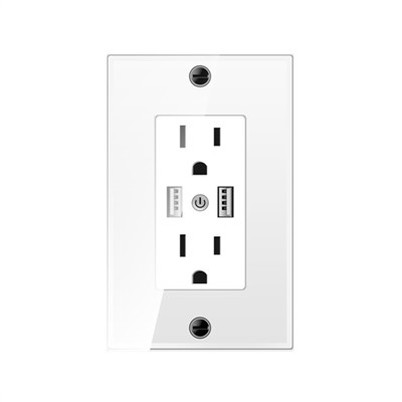
When using a smart socket with a high - power appliance, it's crucial to ensure that the appliance's power requirements are within the socket's rating. For example, our Charging wall socket is designed to handle a specific range of power. If you try to plug in an appliance that draws more power than the socket can handle, the over - current protection may trip, cutting off the power supply. While this is a safety feature, it can be inconvenient and may also indicate that the socket is not suitable for the appliance.
Our Product Range and High - Power Compatibility
USA Standard Socket
We offer a range of smart sockets, including the USA Standard Socket. This product is designed to meet the electrical standards in the United States. It has been carefully engineered to handle a certain level of power, making it suitable for a variety of appliances.
When considering using our smart sockets with high - power appliances, it's essential to check the product specifications. Our technical team has conducted extensive testing to ensure that our sockets can operate safely within their rated power limits. However, we always recommend that customers consult the product manual and follow the installation and usage instructions carefully.
Practical Tips for Using Smart Sockets with High - Power Appliances
- Check the Ratings: Before plugging in a high - power appliance, always check the power rating of the appliance and compare it with the rating of the smart socket. If the appliance's power exceeds the socket's rating, do not use them together.
- Monitor the Temperature: Keep an eye on the temperature of the smart socket when it's connected to a high - power appliance. If the socket feels hot to the touch, it may be a sign of overheating, and you should immediately unplug the appliance.
- Regular Inspections: Periodically inspect the smart socket for any signs of damage, such as frayed wires or loose connections. If you notice any issues, stop using the socket and contact our customer support for assistance.
Conclusion
In conclusion, while it is possible to use a smart socket with high - power appliances, it is crucial to ensure that the socket is compatible with the appliance's power requirements. Our range of smart sockets, including the Charging wall socket and USA Standard Socket, are designed to provide a safe and convenient solution for controlling electrical devices.
If you are interested in purchasing our smart sockets for your high - power or low - power appliances, we invite you to contact us for procurement discussions. Our team of experts is ready to assist you in selecting the right product for your needs and answering any questions you may have. We are committed to providing high - quality smart socket solutions that meet your requirements and ensure the safety of your electrical systems.


References
- Electrical Safety Foundation International. (2023). Electrical safety guidelines for household appliances.
- National Electrical Code. (2023). Standards for electrical wiring and sockets.
- IEEE Transactions on Power Electronics. (2022). Research on the performance of smart sockets under high - power loads.